
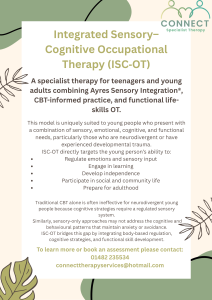
A specialist pathway for teens and young adults who need support with regulation, confidence, and participation.
Our Integrated Sensory–Cognitive OT (ISC‑OT) pathway is a unique, evidence‑informed service designed for young people who experience challenges with emotional regulation, anxiety, sensory processing, executive functioning, and participation in everyday life.
ISC‑OT brings together the best of Occupational Therapy, Ayres Sensory Integration®‑informed practice, and CBT‑informed strategies to support young people in a holistic, meaningful way. The pathway is grounded in the young person’s own voice, using the Child Occupational Self Assessment (COSA) to identify what truly matters to them and what they want to change.
This pathway is ideal for young people (typically 10–25) who struggle with:
- Emotional regulation and anxiety
- Sensory overwhelm or shutdown
- School avoidance or reduced attendance
- Executive functioning (organisation, planning, motivation)
- Low confidence or self‑esteem
- Daily living and independence skills
- Participation in school, college, work or community life
ISC‑OT is especially supportive for autistic young people, those with ADHD, and young people with SEMH needs.
ISC‑OT is a whole‑person, whole‑environment approach.
We look at:
- The Person: sensory needs, emotional patterns, thinking styles, executive functioning, strengths and priorities
- The Environment: school, home, community expectations and sensory demands
- The Occupations: the activities and roles the young person wants or needs to do
This creates a clear, practical understanding of what is getting in the way — and what will help.
Our assessment is gentle, collaborative, and designed to help young people feel understood.
It includes:
✔ COSA (Child Occupational Self Assessment)
A child‑centred tool that helps us understand what the young person finds important, difficult, or meaningful.
✔ Short Sensory Clinical Observations (ASI‑informed)
We look at how the young person responds to movement, touch, sound, and body‑based activities to understand their regulation needs.
✔ CBT‑informed assessment
We explore thinking patterns, anxiety triggers, avoidance cycles, and emotional responses using age‑appropriate tools.
✔ Executive functioning snapshot
A quick look at planning, organisation, flexibility, and task initiation.
✔ Home/School/College environment scan
Understanding the demands and supports in the young person’s daily life.
This assessment leads to a clear, functional formulation and meaningful goals.
ISC‑OT sessions are practical, engaging, and tailored to the young person’s goals.
Intervention may include:
- Sensory and body‑based regulation strategies
- CBT‑informed emotional and cognitive tools
- Executive functioning coaching
- Participation coaching (school, college, work, community)
- Daily living and independence skills
- Interoception and self‑awareness work
- Environmental adaptations and routines
Every session links back to the young person’s COSA priorities, helping them build confidence, self‑advocacy, and independence.
Young people often experience:
- Improved emotional and sensory regulation
- Reduced anxiety and avoidance
- Better engagement in school or college
- Increased independence and confidence
- Stronger executive functioning skills
- Improved participation in daily life
- A clearer understanding of their own needs
- Practical strategies that actually work
We offer flexible ISC‑OT packages:
- 6‑session targeted programme
- 10‑session standard programme
- 12‑session complex needs pathway
Each includes assessment, intervention, and a detailed final report with recommendations for home and school.
ISC‑OT is not a one‑size‑fits‑all approach.
It is a collaborative, strengths‑based, child‑led pathway that helps young people understand themselves, feel more in control, and participate more fully in the things that matter.
If you would like to learn more or discuss whether ISC‑OT is right for your child or setting, please get in touch.